The internet needed a way to grow sustainably. Then, a "tree" entered the stage.
Previously in our “Internet Chronicles” series, we watched Tim Berners-Lee knit the world together with the Web, giving us pages to browse and links to click. But a web of information is useless if the physical network carrying it collapses under its own weight. In the early days of the internet, this was a very real problem.
The primary challenge was connectivity, but the next one was stability. Hardware engineers needed a way to build big, redundant networks that wouldn't self-destruct. They needed a logic that that could be scaled. Enter Radia Perlman, the mathematician who put the internet on a tree.
Learn more in this newest installment of our “Internet Chronicles” series by Andrei Mihai: HLFF Blog
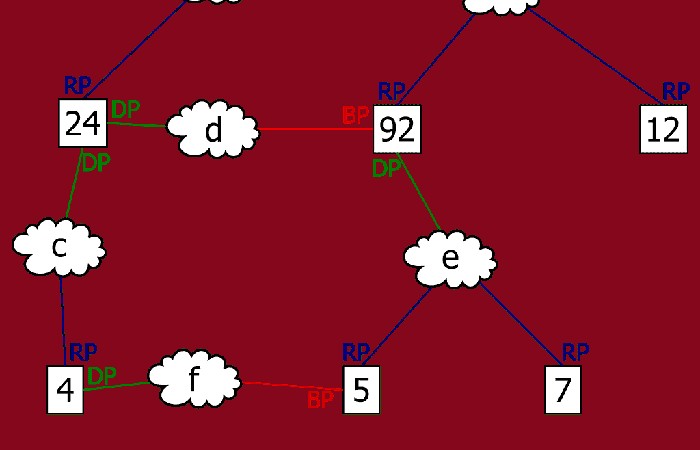
Image caption: Bridges with Spanning Tree Protocol (STP) implementation, as designed by Radia Perlman, in a local area network (LAN). One bridge is the STP root bridge. All bridge ports that connect a link between two bridges are either a root port (RP), a designated port (DP), or a blocked port (BP). Image via Wikipedia (CC BY 3.0)