How did a paper nobody wanted become the foundation of a new field?
In 1968, Stephen Wiesner proposed that quantum effects, then seen mostly as a source of noise, could be used to process information. His paper was rejected, so he put it in a drawer. Had he not told his friend Charles H. Bennett about it, one of the defining scientific fields of the past half-century might have emerged very differently, or much later.
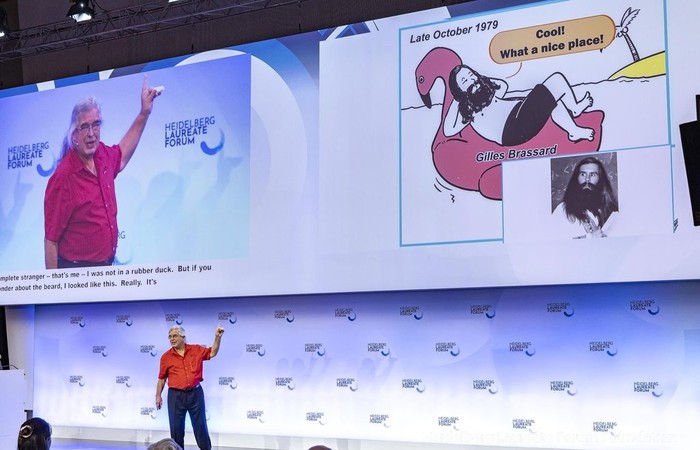
Bennett passed the idea on to Gilles Brassard in 1979, while the two were swimming in the ocean in Puerto Rico. Together, they went on to develop quantum cryptography and help invent quantum teleportation, and in March 2026 they were named recipients of the 2025 ACM A.M. Turing Award. At the 13th Heidelberg Laureate Forum, they explained how physics and computer science came together to create a field, and why the threat of “harvest now, decrypt later” makes its promise so urgent.
This week on the HLFF Blog, Andrei Mihai takes a closer look at the developments that led to their receiving the award: From a Rejected Paper to the Turing Award: How Quantum Information Was Born
Image caption: Gilles Brassard onstage at the 13th Heidelberg Laureate Forum. Image credits: HLFF / Flemming