Stuffing 14 billion years into 40 minutes is quite a challenge.
No one knows exactly when our ancestors began speaking, so how can anyone work out the age of the entire universe? At the 13th Heidelberg Laureate Forum, Nobel laureate Brian P. Schmidt began with a manageable answer: Measure how fast the universe is expanding, then run that expansion backwards.
In this year’s Lindau Lecture, Schmidt explained how hunting for distant supernovae led his team to a startling result. Rather than slowing under gravity’s pull, the expansion of the universe is accelerating, a discovery that earned him a share of the 2011 Nobel Prize in Physics and helped pin down the universe’s age at around 13.8 billion years. The lecture also looked at what is still unresolved, from the nature of dark energy to the Hubble tension.
This week on the HLFF Blog, Andrei Mihai unpacks Schmidt’s lecture: From Supernovae to Dark Energy: How Do You Measure the Age of the Universe?
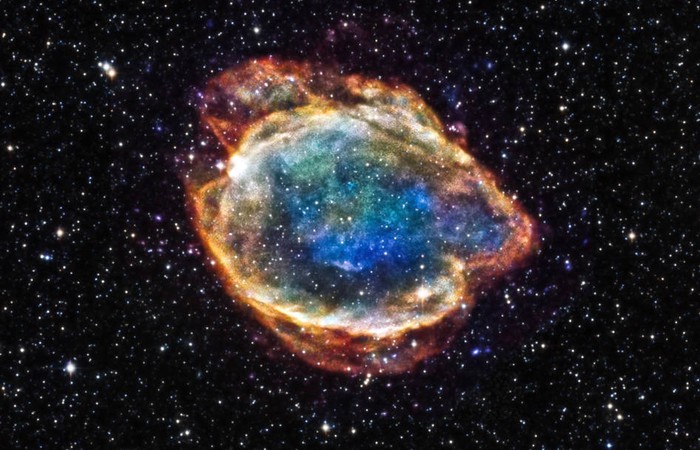
Image caption: G299 Type Ia supernova remnant. Image via Wikipedia Commons (public domain).